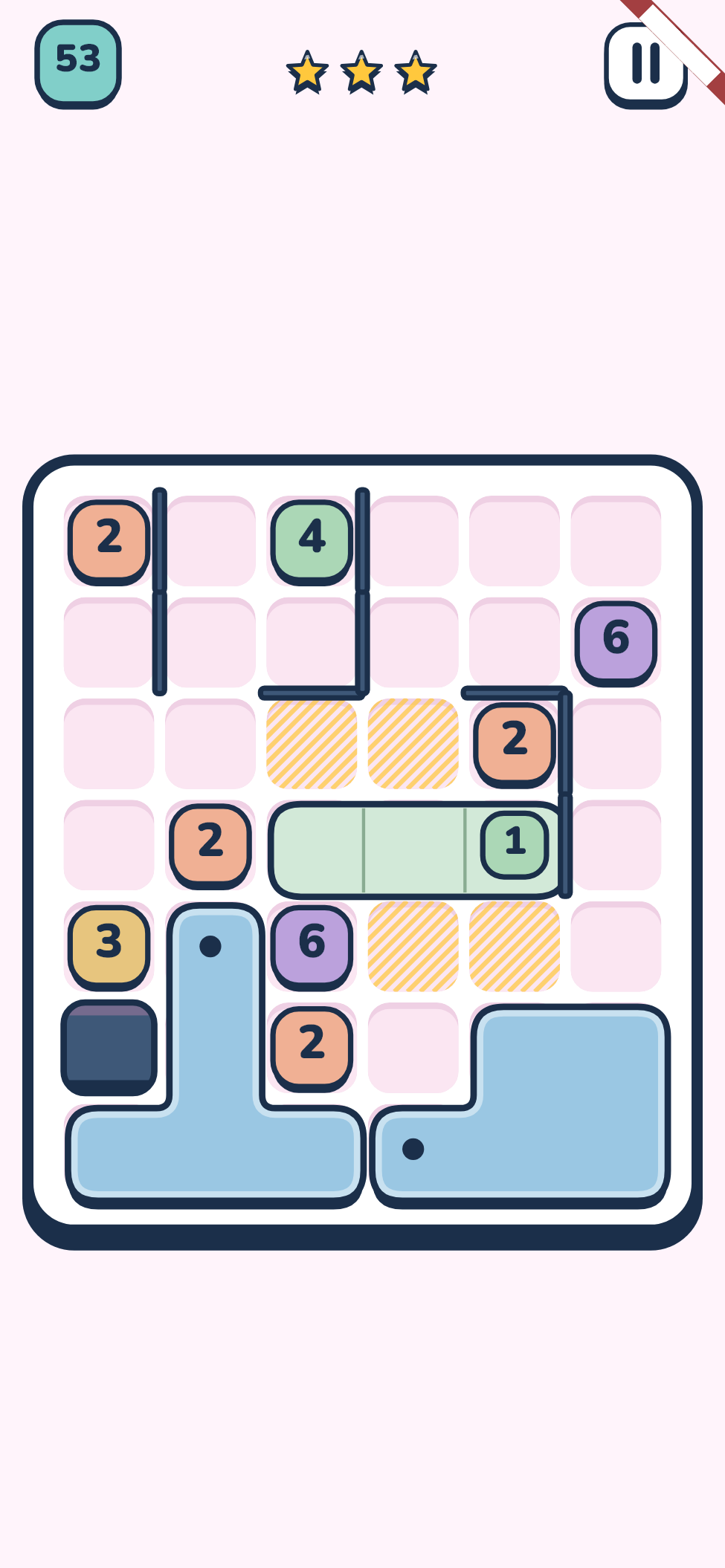
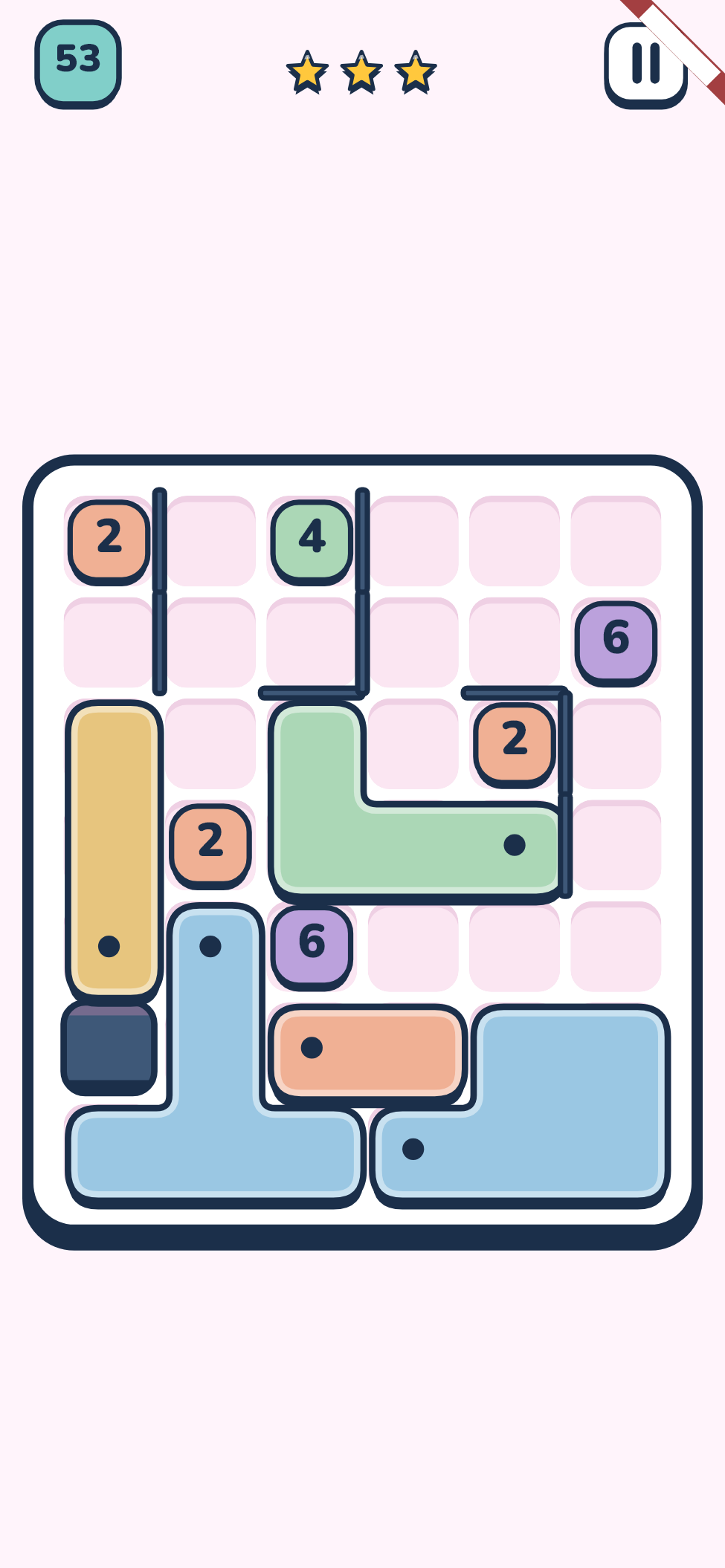
Palmo is a puzzle about splitting a board into patches, from the same family as Fillomino and Shikaku. Every numbered square starts a patch, and its number says how many cells that patch takes.
The rules
- Every numbered square starts a patch. Its number, from 1 to 9, is the patch's size: a 4 takes four cells, a 9 takes nine.
- Touch a numbered square, then take cells one at a time by tapping or dragging. Each new cell must share an edge with the patch, not just a corner.
- The number counts down with every cell. At zero the patch settles.
- A patch holds exactly one numbered square and cannot take a second one.
- A wall runs between two cells and no patch crosses it. No patch takes a stone.
- The board is done when every cell except the stones belongs to a patch.
- Every board has exactly one solution.
While drawing, tap the last cell to give it back, or tap the numbered square to drop the whole patch. Lifting your finger undoes nothing.
To redo a settled patch, hold your finger on it until it comes apart. Each level gives you three extra strokes; every unpick uses one, and those left when the board closes are your stars.
Special rules
Later levels mark some numbers with a small sign that adds one rule to their patch. The game explains each rule on a card when it first appears.
- Set square (small corners around the number). The patch is a rectangle.
- Strip (a bar). The patch is a straight line, one row or one column.
- Mirror (a half-moon). The patch mirrors itself across a vertical or a horizontal axis. Diagonal symmetry does not count.
- Seam (a cross, on two numbers joined by a dashed thread). The two patches must share an edge, even one with a wall on it.
A move that breaks a rule is turned down on the spot and costs no stroke.
Boosters
Three boosters help when you are stuck. None of them adds stars.
- Lantern settles one correct patch for you and costs no star.
- Unpick takes a settled patch apart without burning a star. It still works when your extra strokes have run out.
- Compass marks the patches that sit in the wrong place. If every patch is right, it costs nothing.
You start with two of each and earn more as you play.
Tips
- Settle the 1s first. A 1 settles the moment you touch it, and every cell it takes is one less to think about.
- Count what a number can reach. A patch reaches at most its number minus one steps from its square, and walls, stones, other numbers and settled patches block it. If a 6 in a corner can reach exactly six cells, those are its patch.
- Look for cells only one number can reach. Such a cell belongs to that number. Likewise, if a 5 sits in a three-cell pocket with one way out, the cell in the opening is part of the 5.
- Mind the dead ends. A cell closed on three sides by the edge, walls, stones or settled patches shares its patch with the cell on its open side, unless it is a 1 itself.
- Add up closed areas. When walls, stones and settled patches cut off an empty area, its numbers must add up to its cell count. If not, a placed patch is wrong; the game marks the area with a pink pulse.
- Read the marks. A rectangle of 5 or 7 cells is one cell wide, so a Set square 5 or 7 is a straight line.
Questions
Is there a timer?
No, levels have no clock. The one exception is the tear: after some levels a small three-patch board opens with ten seconds on it. You can skip it, and running out of time costs nothing.
Does it play offline?
Yes. Levels need no connection and nothing asks you to sign in. Linking a Google or Apple account is optional and only moves your progress to another device.
Is it free?
Yes. There are ads between levels, and a one-time purchase removes them.
Is it like Fillomino or Shikaku?
Same family. As in Shikaku, each patch holds one number that gives its size, but only a Set square forces a rectangle. Unlike Fillomino, every patch starts from its own number, and patches of the same size may touch.
What if the board will not close?
Palmo checks the board after every patch and tells you when it can no longer be finished: “This board won't close.” Hold the wrong patch to unpick it, or use the Unpick booster once your extra strokes are gone. The Compass shows which one is wrong.